In the first week of November, Fira Gran Via in Barcelona ran the world's largest smart city congress and one of Europe's main cybersecurity congresses at the same time, in neighbouring halls, on the same badge. Expertware was there, as part of the Romanian delegation. The programming of those two events in one venue is not a scheduling accident, and the reason it happened in Barcelona rather than anywhere else is the most useful thing we brought home.
One week, one venue, two congresses
Smart City Expo World Congress ran from 3 to 5 November at Fira de Barcelona's Gran Via venue, in its fifteenth edition, under the theme "Urban Solutions, Real Impact". It gathered delegates from a thousand cities, more than 27,000 attendees, upwards of 1,100 exhibitors and 600 speakers across 150 sessions.
On the same dates, in the same venue, the seventh Barcelona Cybersecurity Congress ran under the theme "Connecting the European Cybersecurity Ecosystem", with more than 150 speakers, 111 companies and 34 sponsors in its exhibition area. Its programme was built on three pillars: cybersecurity as a strategic business and reputation asset; artificial intelligence, identity and trust in the digital environment; and systemic, cyber-physical and supply chain risk.
Two details are worth pausing on, because they are the whole argument of this article.
The first is that the two congresses are co-located by design, on shared passes, alongside Tomorrow.Mobility, the Barcelona Deep Tech Summit and HOWS Barcelona, the housing world summit. A city official who came to talk about housing or mobility walks into a cybersecurity hall without meaning to. That is a deliberate piece of programming, and most countries still treat these two conversations as separate industries with separate budgets.
The second is who organises the cybersecurity congress. BCC is run by Fira de Barcelona in partnership with the Agencia de Ciberseguretat de Catalunya, the regional public cybersecurity agency. A public cyber authority does not sponsor the event from the sidelines. It co-owns it.
For completeness: the same halls had hosted CrowdStrike's Fal.Con Europe from 2 to 4 November. For one week, Fira Gran Via was where Europe decided what it thinks about cities, data and defending both.
Why Barcelona, and not somewhere else

Barcelona has hosted the smart city congress since 2011, long enough to have become its own case study.
From 2015 the city ran an explicit technological sovereignty agenda: data sovereignty clauses written into public procurement, so suppliers hand back the data they collect on the city's behalf, a municipal data office, ethical digital standards published as a toolkit for other cities, and the EU-funded DECODE pilots that let residents decide what happens to data about them. Barcelona did not become the reference smart city because it bought the most sensors. It became the reference because it decided who owns what the sensors produce.
Then it learned the other half of the lesson, in public.
On 5 March 2023, Hospital Clinic de Barcelona detected ransomware on its virtualisation platform and notified the Catalan Cybersecurity Agency the same morning. Around 3,000 appointments and 150 surgeries were cancelled, patient and staff data later appeared on the dark web, and the Catalan data protection authority found afterwards that the required security measures had not been in place.
Put the two stories side by side and the shared hall explains itself. Data governance decides who holds the risk. Incident response decides how long the city stays down. In most administrations they are the same policy, split across two budget lines.
Romania in the room, Expertware in both halls
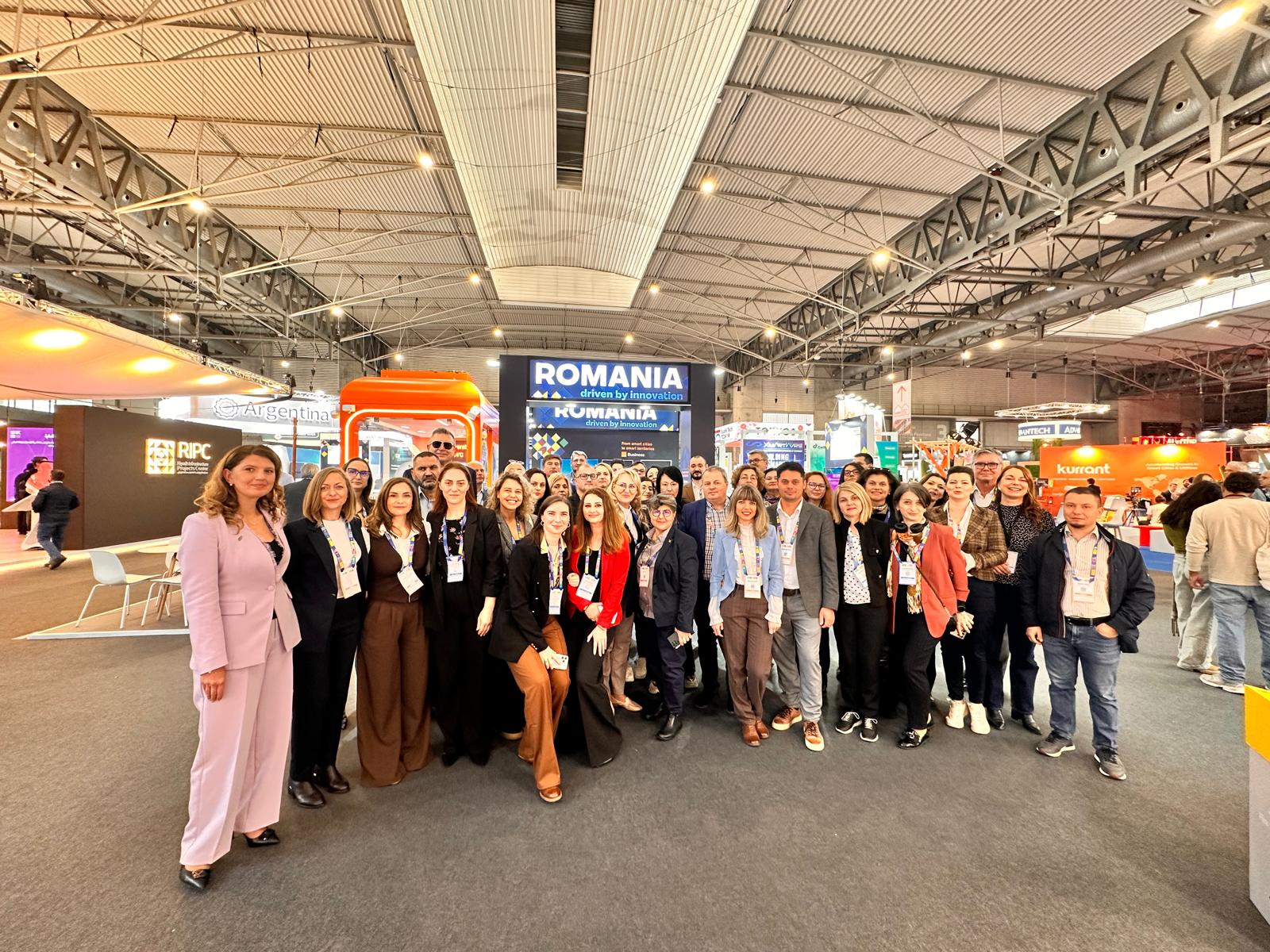 Romania was present at Smart City Expo with a national pavilion, alongside regional delegations. One of the larger ones came from the North-East region, with more than 50 participants drawn from the regional development agency, local public administration and private companies. Mayors, county officials and operators of public services spent three days looking at what other cities have already deployed.
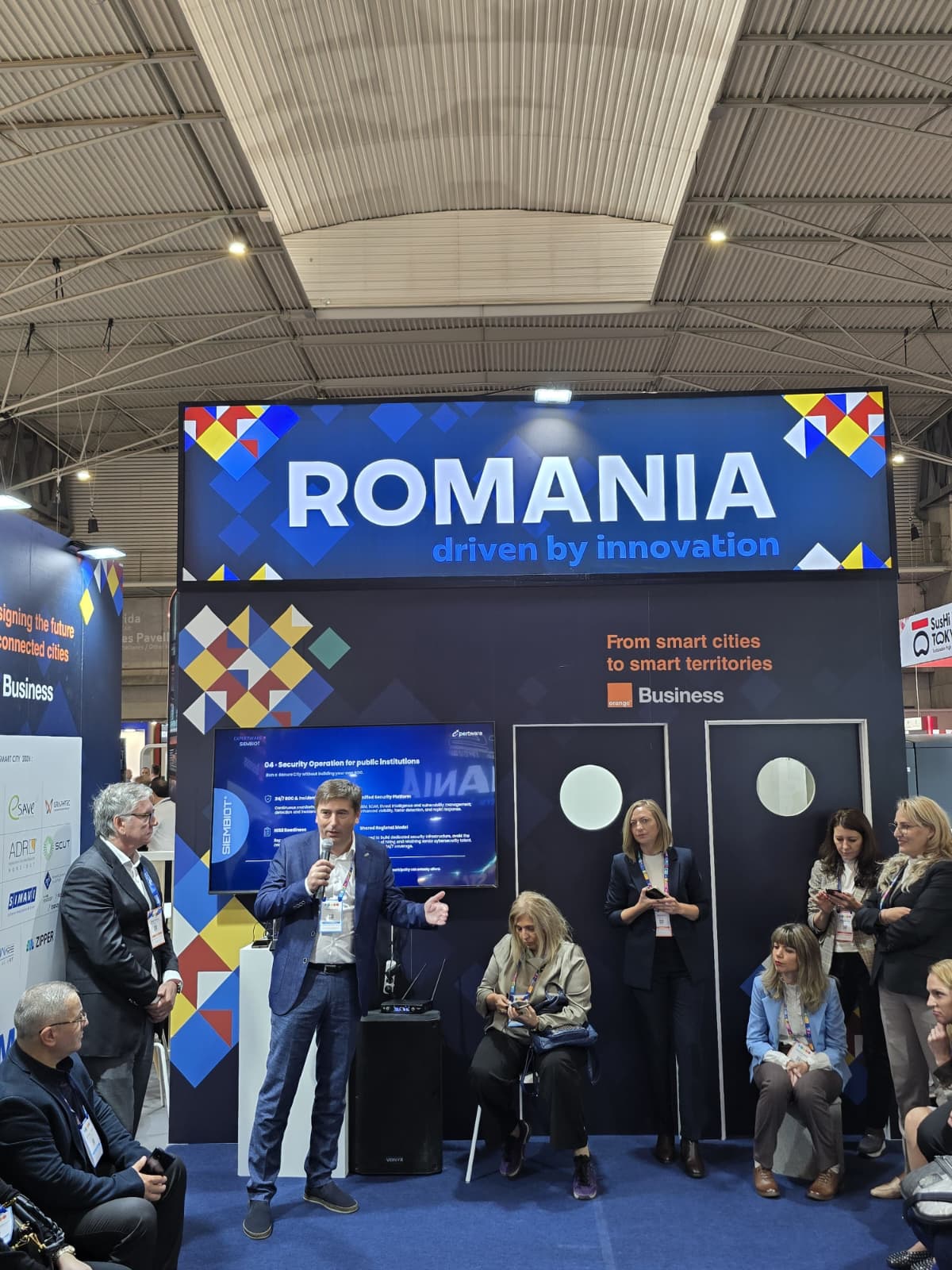 Expertware took part in both exhibition halls as part of the Romanian delegation, organised with the support of Digital Innovation Zone and ADR Nord-Est. At the Romania pavilion, our co-founder Tiberiu Baraboi presented the company and the cyber and IT solutions we build for the services a city actually runs on. In the smart city halls, the questions are about those services: transport, lighting, housing, utilities, citizen platforms. In the cybersecurity hall, the questions are about what happens when they stop.
We work on that second challenge, helping protect the organisations that keep essential services running.
That international opening is also visible at institutional level. Romania's National Cyber Security Directorate (DNSC) and the Agencia de Ciberseguretat de Catalunya are counterpart institutions that work closely together, and the relationship was reinforced at this year's BCC through direct dialogue between the two leaderships, on the exchange of good practice, coordinated incident response and the protection of critical infrastructure, healthcare included. After what Catalonia went through in 2023, that last point is not an abstract agenda item.
SIEMBIOT has the same shape on a different scale. It is a European research and innovation project under EU grant 101127939, coordinated by Expertware with DNSC as partner. The authority brings the national picture, the mandate and the trust. The company brings the engineering, the platform and the people who operate it at three in the morning.
That pairing is not a formality. It is the reason our joint webinar with DNSC on cybersecurity for public institutions under NIS2 drew more than 1,235 participants, most of them from administrations that had never had a conversation about incident response before the directive forced one. An authority alone publishes guidance. A vendor alone sells a licence. The two together change what an institution is actually able to do on a Monday morning.
What we took away, and what we think transfers
These are impressions rather than a policy paper. Four of them stayed with us after the halls emptied, and none requires a city the size of Barcelona.
The first thing we noticed was who was standing where. At the cybersecurity congress, the regional public agency was not a guest with a stand. It was the co-organiser. We have been building that same arrangement in Romania through SIEMBIOT, often having to explain why an authority and a company should publish together. Watching it run at this scale in Catalonia was a useful answer.
The most copyable thing Barcelona did costs nothing to implement. It wrote data ownership into its supplier contracts. A clause is enforceable, a strategy document is not. We came home thinking that any municipality buying a parking platform, a transport app or a utility management system should be asking four questions inside the tender itself: who holds the data, where does it sit, who can read it, and what happens to it when the contract ends.
We kept hearing cities describe themselves as service operators rather than as critical infrastructure. NIS2 already disagrees. Water, transport, health, energy and public administration carry the obligations whether or not a municipality thinks of itself as a technology operator: risk management, incident reporting, accountability at management level. The Catalan case shows what the follow-up looks like when the measures were not in place beforehand.
The fourth one is the uncomfortable one, and it is the one we work on daily. Most public institutions discover their exposure during an incident or during an inspection. Both are expensive ways to learn. We would rather a customer find out on an ordinary Tuesday, from a dashboard, while there is still time to do something about it.
There is a fifth impression that does not fit in a bullet. Barcelona has been having this conversation in public for fifteen years. The congresses are not where the city shows off, they are where it recruits other cities into the same argument. That habit is worth more than another strategy document, and it is the part we would most like to see taken up at home.
Where our solutions fit
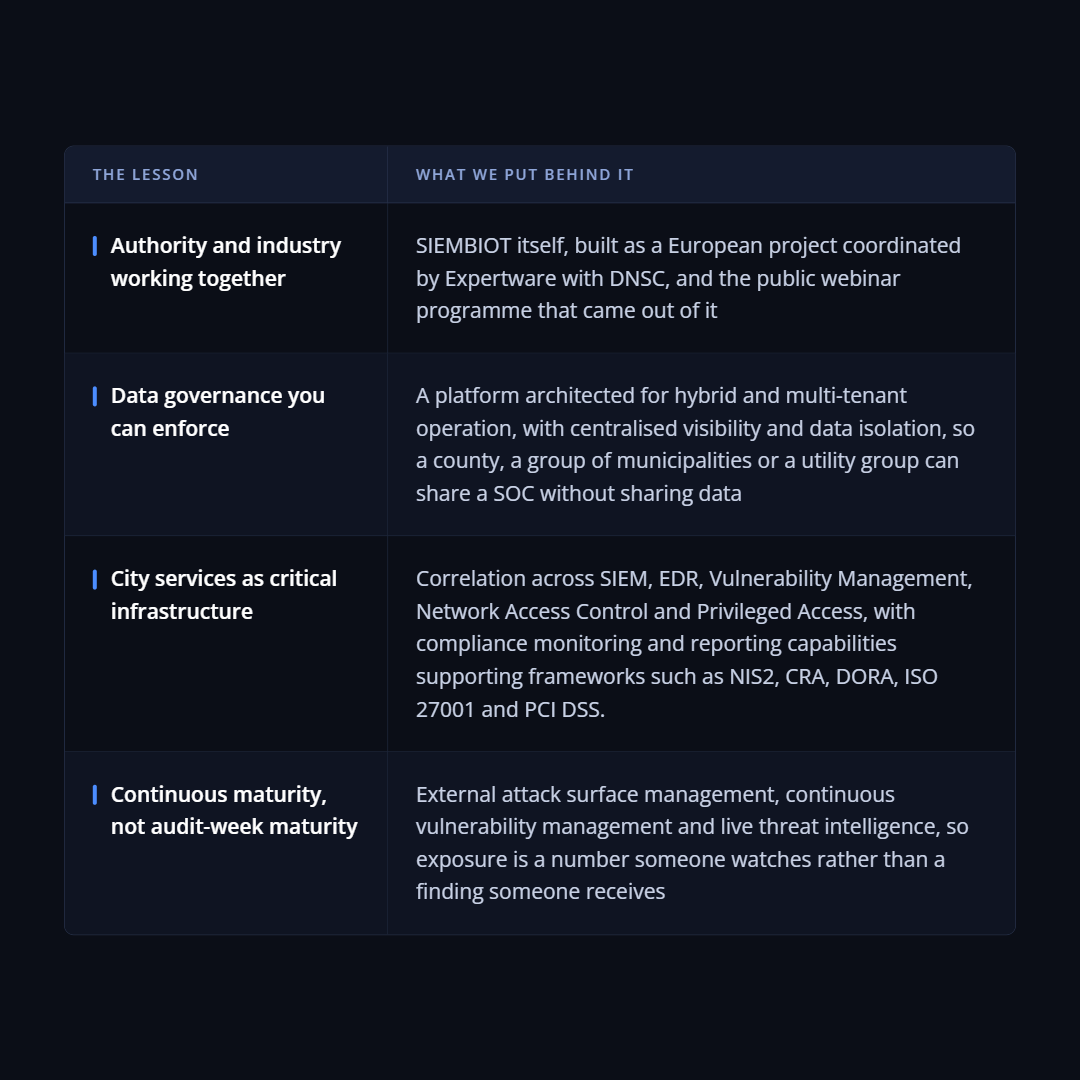
One more piece belongs here, because the Barcelona conversation keeps returning to it: people. A municipality can buy a platform in a quarter and still be unable to run it, because nobody on the team has handled an incident before. That is why our Cyber Academy and cyber range work sits beside the platform rather than after it. The first hour of a real incident is not the moment to discover what the procedure says.
What we brought home
The useful takeaway from Barcelona is not a technology. It is an organising principle: the city that treats data governance and cyber defence as one policy ends up with both, and the city that treats them as two procurement categories usually ends up with neither.
Romania has the institutional pieces for that argument already. What is missing in most places is the habit of putting them in the same room often enough.
If you run services a community depends on, in a municipality, a utility, a hospital or a county administration, we can show you what visibility and incident response look like when they are built for that setting rather than retrofitted onto it.
Talk to our team, or start with a 30 day trial of the SIEMBIOT platform.
Sources
Housing, AI and climate action take centre stage at the 15th Smart City Expo World Congress, The New Barcelona Post
Barcelona Cybersecurity Congress to address the impact of AI on cybersecurity, Fira de Barcelona, 26 October 2026
The Barcelona Cybersecurity Congress will gather the European cybersecurity ecosystem, Fira de Barcelona, 8 June 2026
The right to the (digital) city, Barcelona Metropolis
Common Knowledge: citizen-led data governance for better cities, Nesta and DECODE
Hospital Clinic de Barcelona, communications on the March 2023 ransomware attack and the sanctioning procedure PS 1/2024, Autoritat Catalana de Proteccio de Dades
El Clinic, en jaque por el ciberataque, Redaccion Medica


30 Days of Enterprise-Grade Cyber Defense
Step into the future of cybersecurity with full access to a unified, intelligent platform — free for 30 days. Empower your security team with:
Advanced SIEM for real-time visibility, smart alerting, and deep forensics across cloud, on-prem, and hybrid environments
Continuous Vulnerability Management to identify, prioritize, and remediate risk across all assets
Live Cyber Threat Intelligence integrated directly into your workflows, with global insights and attacker profiling
AI-Powered Threat Detection that learns from your environment, explains alerts in plain language, and suggests next steps
Built-in Compliance Readiness for NIS2, GDPR, ISO 27001, and more, with automated reporting and audit tools
Whether you're managing a lean SOC or a full-scale enterprise security team, this platform gives you the tools to detect faster, respond smarter, and stay ahead of evolving threats — all without the complexity.
Experience enterprise-grade protection, streamlined workflows, and total control.
Your 30-day head start begins now.
Unlock Your 30 Days Free Trial


